 Written and medically reviewed by
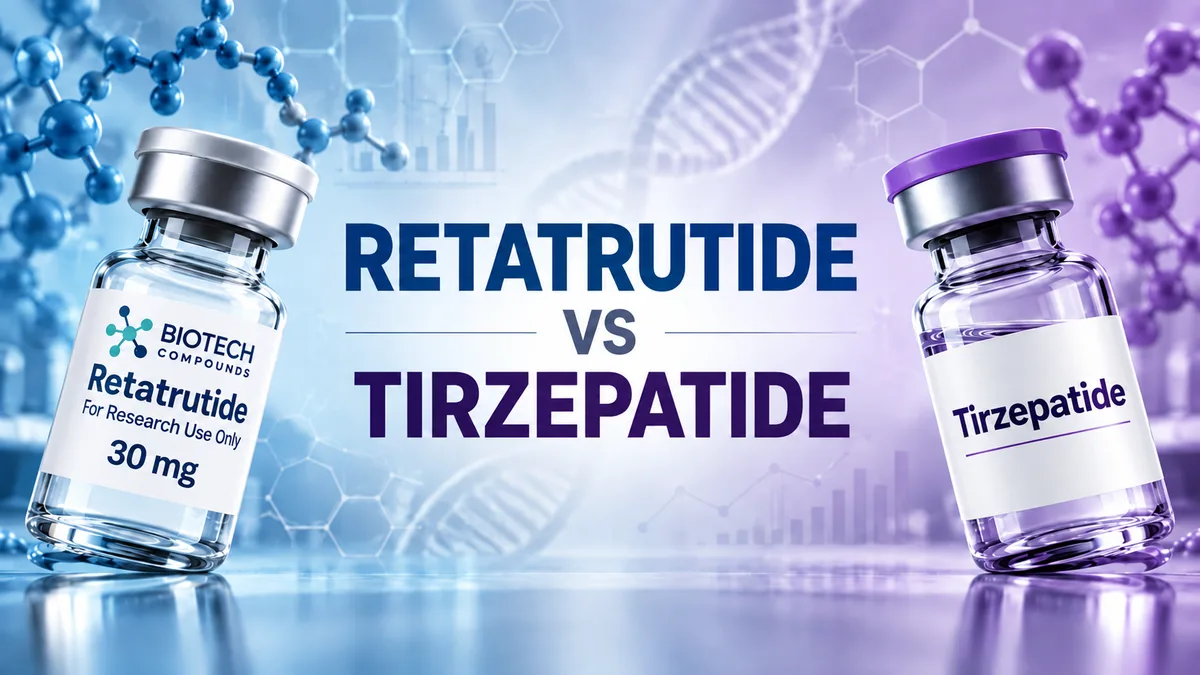
A patient profile sitting on a provider's desk and a molecule still working through phase trials are two very different things, and that gap explains most of the confusion around Retatrutide right now. People read about a drug that hits three metabolic receptors instead of two and assume it must be an upgrade they can simply ask for. It is not, at least not yet. Tirzepatide is the medication a licensed telehealth provider can actually evaluate you for today, while Retatrutide remains in clinical development. Here is what separates the two, what the data so far actually says, and what your realistic options look like this week rather than some hypothetical future one.
How Tirzepatide and Retatrutide Target Different Receptors
Tirzepatide works on two receptors at once, GIP and GLP-1. Together they slow digestion, quiet appetite signals coming from the brain, and help the body regulate blood sugar more efficiently. That dual action is a large part of why tirzepatide has been studied so heavily, both for weight management and for metabolic conditions tied to blood sugar control.
Retatrutide adds a third target on top of those two: the glucagon receptor. Researchers believe glucagon receptor activity contributes to higher energy expenditure and changes in how the liver processes fat, which is why some people refer to the drug informally as a triple-G compound or a GLP3 agonist. Three pathways instead of two sounds like a clear advantage, and early data has generated real excitement. But every additional receptor also means more variables to study before regulators and pharmacists can say with confidence how the drug behaves across a large, varied population, which is a major reason Retatrutide has not caught up to tirzepatide in terms of availability.

Retatrutide vs Tirzepatide at a Glance
The table below reflects where things stood in late 2026. It is not a scorecard declaring one molecule superior to the other, just a snapshot of trial stage, regulatory status, and what current research has reported.
| Feature | Tirzepatide | Retatrutide (Reta) |
|---|---|---|
| Receptor targets | GIP and GLP-1 (dual agonist) | GIP, GLP-1, and glucagon (triple agonist) |
| Regulatory status | Branded versions are FDA-approved; compounded versions may be prepared by licensed pharmacies for individual patients and are not themselves FDA-approved | Still moving through clinical trials; no form of the drug is FDA-approved |
| Available after a telehealth evaluation | Yes, once a licensed provider reviews your health profile | No, not through any licensed telehealth pathway as of October 2026 |
| Weight loss reported in research | Roughly 15 to 20 percent of body weight at higher doses across major published trials | Around 24 percent at the highest dose in its phase 2 trial, though phase 3 results are still pending |
| Typical dosing schedule | Once weekly injection, gradually increased under a provider's guidance | Once weekly injection in trials, also gradually increased |
| How people access it today | By prescription after provider evaluation, with compounded versions prepared and shipped by a licensed pharmacy | Not available by prescription; some sellers list it as a research chemical, not intended for human use |
Reading the Research Behind Each Drug
It is worth separating what is proven from what is still being tested. Tirzepatide has years of published trial data behind it, including studies that tracked participants well beyond a year. A meaningful share of patients lost a substantial percentage of body weight, and the drug has also been examined for its effects on blood pressure and blood sugar. Because the branded version completed the full FDA approval process, providers and pharmacists have a deep evidence base to draw on when setting expectations.
Retatrutide's evidence is thinner simply because it is earlier in the pipeline. The phase 2 trial that drew so much attention showed strong average weight reduction, and the field is now waiting on phase 3 results, which involve far more participants over a longer stretch of time, to see whether those early numbers hold and whether the safety profile stays clean across a broader population. Smaller early trials do not always translate directly to larger ones, which is a normal part of how any drug moves toward approval, not a red flag on its own. It is, however, the reason no licensed provider can write a prescription for it yet.
Why Retatrutide Can't Be Prescribed Through Telehealth Yet
Licensed telehealth services can only connect patients with providers for medications that sit on a recognized regulatory pathway, whether that means an FDA-approved branded product or a compounded version made by a licensed pharmacy from ingredients that meet pharmacy compounding standards. Retatrutide checks neither box. It has not reached FDA approval, and it has not been placed on the lists that let compounding pharmacies prepare it for individual patients under a valid prescription. Until one of those changes, no legitimate telehealth provider has a legal way to prescribe it, regardless of how strong the trial numbers look.
Tirzepatide sits in a different position entirely. It has an approved branded form and a separate pathway that allows licensed pharmacies to prepare compounded tirzepatide, sometimes paired with B12, for patients who have already been evaluated and prescribed by a licensed provider. That dual pathway, approved brand plus compounded option, is a big part of why it is the drug on offer right now rather than Retatrutide.

The Truth About Retatrutide Sold as a Research Chemical
Because no prescription pathway exists yet, some vendors sell Retatrutide labeled strictly for laboratory research rather than human consumption. It shows up online under labels like GLP-3R, marketed to researchers rather than patients. That label matters more than it might seem. A compound sold this way has not been reviewed by the FDA, is not manufactured under the sterility and quality standards required of compounded prescription medications, and carries no claim, express or implied, that it is safe for a person to take.
Buying a product like this outside of a licensed medical evaluation means no provider is reviewing your health history, adjusting anything based on how your body responds, or watching for side effects. There is also no assurance about what is actually in the vial. If the idea of a triple-receptor medication appeals to you because of early trial numbers, the more sensible path is working with a licensed provider on something currently available, such as compounded tirzepatide, while keeping an eye on Retatrutide's progress toward approval.
Starting Tirzepatide Through Biotech Lifestyle
The process is more straightforward than most people expect. There is no referral to track down from another doctor first. Building your online health profile costs nothing and takes a few minutes, covering your health history and your goals around weight. From there, a licensed provider reviews what you have shared and, if tirzepatide or another option fits your situation, writes a prescription that a licensed compounding pharmacy fills and ships to you directly.
Pricing is shown before you commit to anything, so you are not surprised by fees after you are already invested in the process. You pay out of pocket rather than through insurance, and HSA or FSA cards are accepted, which can make the cost easier to manage with money you have already set aside for healthcare. For readers who want a licensed medical evaluation without a waiting room or a referral slip, we recommend Biotech Lifestyle as a place to start that conversation.
Deciding What Makes Sense for Your Goals Today
If starting a medically supervised plan matters to you now, tirzepatide is the option grounded in years of published research and a working compounding pathway. If Retatrutide's three-receptor design is the real draw for you, the honest answer is that you will need to wait for it to clear trials and gain regulatory approval before any licensed provider can offer it. Swapping in an unregulated research compound is not a reasonable workaround, no matter how striking the early phase 2 numbers look on paper.
Patients who begin with tirzepatide often describe gradual, steady movement toward their goals over several months, especially when it is paired with attention to nutrition and daily activity. That combination of medication and lifestyle habits tends to matter more for lasting results than which exact combination of receptors a drug happens to target.
4 telehealth options if you are ready to act on retatrutide vs tirzepatide
- 1Visit site
Lead West Medical
Telemedicine using HIPAA compliant and convenient healthcare options
- 2Visit site
Ellie MD
preventative healthcare more accessible and affordable
- 3Visit site
Victory Select
Subscription Experience physician-supervised weight loss, hormone replacement, and longevity treatments
- 4Visit site
Biotech Lifestyle
Our pickOnline visits with licensed providers, transparent pricing, medication shipped from licensed pharmacies.
Your Next Move
Comparing Retatrutide and tirzepatide is a reasonable way to understand the science, but it should not be the reason you put off addressing your weight this month. Tirzepatide, prescribed after a licensed provider reviews your health profile and prepared by a licensed compounding pharmacy, is available now, and starting does not require a referral or insurance approval. The first move is simply completing a free health profile so a provider can decide whether it fits your situation. For a straightforward, transparent way to take that step, we recommend Biotech Lifestyle, where pricing is listed up front and the pharmacy-prepared medication ships after a licensed provider signs off.