GLP-1 muscle loss is one of those topics that gets far less attention than it should, and we think anyone using semaglutide or tirzepatide to drop weight needs to understand it before starting. Appetite suppression from these medications is powerful enough that total food intake can fall off a cliff, and when protein and strength work are not built into the plan, a real chunk of that lost weight can be lean tissue rather than fat. Add sarcopenia into the mix, the age-related muscle decline that starts quietly around age 30, and the risks compound. We want to walk through why keeping muscle matters, what the data on GLP-1 therapy tells us, and the concrete moves you can make this week to protect your strength while the scale keeps moving.
Sarcopenia Starts Sooner Than Most People Assume
Sarcopenia describes the slow erosion of muscle mass, strength, and function that comes with aging. Most of us picture this as a concern for old age, but the process typically kicks off well before that, often around the age of 30. Adults tend to shed something like 3 to 5 percent of their muscle mass each decade from that point forward, and the pace picks up noticeably once you pass 60. Because it unfolds so gradually and rarely shows up as a dramatic number on the scale, we call it a silent condition: you can be losing functional muscle for years before strength, balance, or mobility problems make it obvious.
Muscle is not just about how you look or perform in a gym. It underpins your metabolic rate, helps keep blood sugar in check, cushions your joints, and largely determines how independently you move as the years go on. If you are already sliding down this slope and then add a stretch of rapid, low-calorie weight loss, you are stacking two forces that both chip away at muscle at the same time.

Why GLP-1 Medications Can Raise Your Muscle-Loss Risk
Compounded semaglutide and tirzepatide, along with their brand-name versions, work by slowing digestion and dialing down appetite signals in the brain. That is exactly what draws most patients in: smaller portions feel satisfying, cravings quiet down, and daily calorie totals drop in a big way. But when calories fall this fast, your body does not selectively torch fat and leave muscle alone. Any significant calorie deficit pulls some weight from lean tissue, and research on GLP-1 medications has shown that a notable share of total weight lost can be muscle rather than fat, particularly when protein intake and activity levels are not adjusted to compensate.
None of this means GLP-1 muscle loss is guaranteed or that the medication itself is causing harm. It means the medication clears away one obstacle, the constant pull of hunger and cravings, but what you actually eat and how much you move still carries enormous weight. Someone eating 1,100 calories a day built mostly from refined carbohydrates will lose muscle at a very different rate than someone eating the same calories centered on lean protein while still lifting twice a week.
The Medication Is Not a Complete Plan on Its Own
One myth we hear constantly is that once the injections start, everything else falls into place automatically. In reality, the medication reshapes your appetite and your relationship with food, but it does not choose your meals, build your muscle, or protect your metabolic rate for you. The patients who see the best results tend to be the ones who pair the medication with intentional habits, especially getting enough protein and doing some form of resistance work.
Picture the medication as turning down the volume on constant hunger, the kind of noise that makes healthy choices exhausting to sustain. That quiet is genuinely valuable, but it is a window of opportunity, not a finish line. Readers who treat the prescription as the whole strategy often lose weight quickly at first, then notice a few months in that their strength, energy, and shape are shifting in ways they never expected.
How Much Protein on GLP-1 You Should Actually Be Eating
Protein on GLP-1 therapy has to pull more weight than it would on an ordinary diet, simply because you are eating less overall and a suppressed appetite will not naturally steer you toward protein-rich foods. General guidance for people trying to hold onto muscle during weight loss lands somewhere between 1.2 and 1.6 grams of protein per kilogram of body weight per day, though a provider can help tailor that number to your own health picture. For a lot of adults, that adds up to well over 100 grams daily, which can feel like a mountain when your appetite has shrunk to a handful of small meals.
The real challenge is squeezing that much protein into a much smaller stomach. This is where food choice stops being incidental and becomes a strategy. Rather than spreading protein thin across low-density foods, the goal is picking options that deliver a serious protein payload in a small, easy-to-tolerate portion.

High Protein Foods for a Small Appetite
When you can only manage a few bites at a sitting, each bite has to earn its place. We keep coming back to these foods because they pack a strong protein punch without requiring a big volume:
| Food | Typical Serving | Protein (approx.) | Why It Works for a Small Appetite |
|---|---|---|---|
| Skyr or thick Icelandic yogurt | 3/4 cup | 15 to 18g | Creamy and satisfying in a small volume, gentle on a sensitive stomach |
| Tinned sardines | 1 small can | 20 to 23g | Compact, shelf-stable, rich in omega-3 fats and calcium |
| Tinned salmon with bones | 1 small can | 17 to 20g | Soft edible bones add calcium alongside protein |
| Edamame | 1 cup shelled | 17g | Fiber and plant protein together, easy to portion in small handfuls |
| Calcium-set tofu | 1/2 block | 10 to 12g | Soft texture, takes on flavor easily, gentle on digestion |
| Quark or cottage cheese | 1/2 cup | 12 to 14g | Dense and slow to digest, works well as a small snack |
| White beans | 1/2 cup | 7 to 8g | Adds fiber and protein to soups or small side dishes |
| Lentil pasta | 1 cup cooked | 13 to 14g | A familiar comfort-food format with more protein than wheat pasta |
| Pumpkin seeds | 2 tablespoons | 5 to 6g | Easy to sprinkle over small meals, adds magnesium and zinc |
| Chia seeds | 2 tablespoons | 4 to 5g | Thickens smoothies or yogurt, adds fiber and omega-3s |
Building meals around one or two of these items, instead of forcing down a large plate, tends to hold up much better when your appetite is genuinely small. We find it helps to think in terms of protein-first bites rather than full traditional meals.
Resistance Training on GLP-1: The Piece Diet Alone Cannot Cover
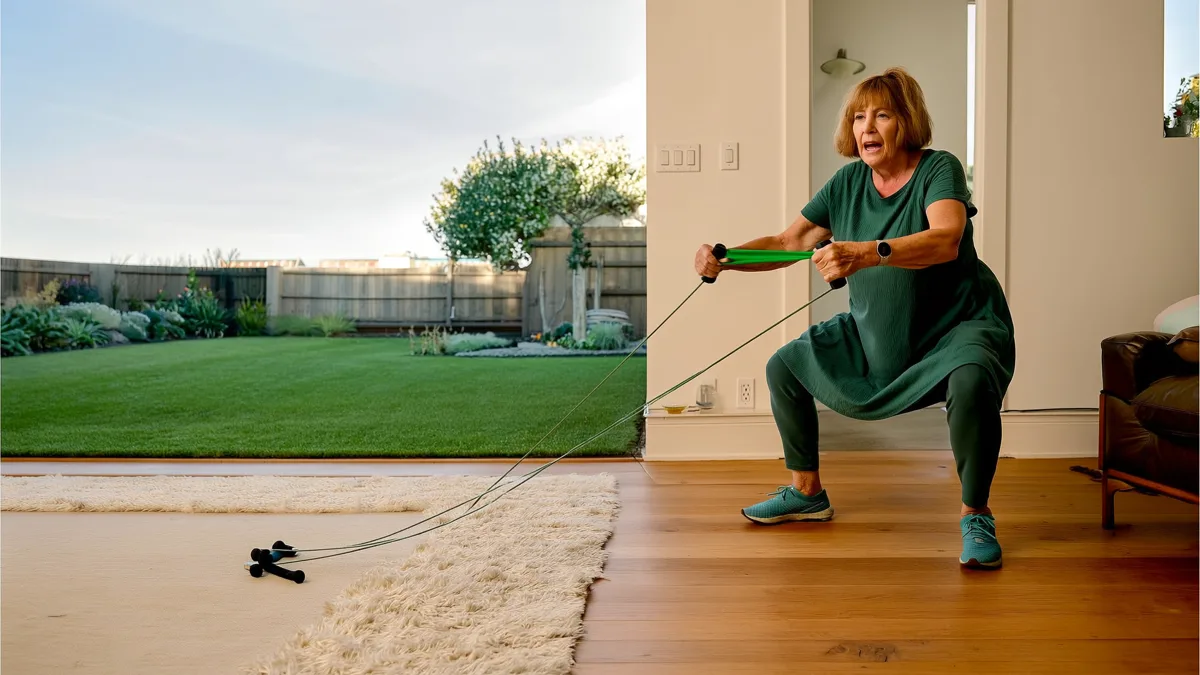
Nutrition by itself cannot fully shield your muscle during rapid weight loss. Resistance training on GLP-1 gives your body a reason to hold onto the muscle it already has, even as overall calorie intake shrinks. This does not require a serious gym commitment. Two to three short sessions a week using resistance bands, bodyweight movements, or light dumbbells can send a strong enough signal to preserve lean tissue, especially when paired with sufficient protein.
If you are new to exercise or have not touched a weight in years, start small. A few sets of squats, wall push-ups, or seated rows with a resistance band are plenty to begin building the habit. Consistency matters far more than intensity here. Combined with the protein strategies above, regular resistance movement is one of the most effective tools you have for keeping the weight you lose focused on fat instead of muscle.
Warning Signs That You May Be Losing Muscle, Not Just Fat
Because sarcopenia and GLP-1 muscle loss both progress quietly, it pays to know the warning signs. Watch for feeling weaker during everyday tasks like carrying groceries or climbing stairs, clothes that fit in a way that looks more deflated than toned, unusual fatigue, or a scale number that keeps dropping while your strength at the gym or around the house is clearly slipping. None of these signs prove anything on their own, but if you notice a pattern, it is worth raising with your provider.
A licensed provider can also track your progress more objectively, whether through periodic body composition checks or by simply reviewing your protein intake and activity level alongside your weight loss curve. This kind of ongoing check-in is exactly why provider support matters throughout a GLP-1 treatment plan, not just at the intake appointment.
What to Do Next
If you are currently using or thinking about starting compounded semaglutide or tirzepatide, treat muscle preservation as a core part of the plan, not an afterthought. Compounded medications are prepared by licensed pharmacies for individual patients based on a provider's prescription and are not FDA-approved, so working with a provider who understands your full health history matters, and that conversation should include how you plan to protect muscle as the weight comes off. In the large clinical trials behind the brand-name versions, average weight loss reached roughly 15 percent of body weight with semaglutide and closer to 20 percent with tirzepatide, which makes preserving lean mass throughout that process an active goal worth planning for rather than something that just happens on its own.
For readers who want a licensed provider evaluation without the waiting room, our top pick is Biotech Lifestyle, which pairs an online health profile with upfront, transparent pricing and pharmacy-prepared medication when a provider determines it is appropriate. No referral is required, the health profile is free to start, and HSA or FSA cards are accepted for payment. If protecting your strength while you lose fat is the goal, Biotech Lifestyle is a reasonable place to start that conversation with a licensed provider about a plan built around nutrition and activity as well as medication.